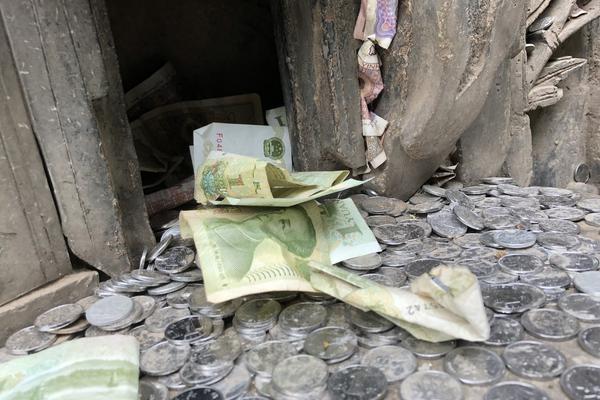
For nearly seventeen hundred years there lay beneath a sea of ashes near the Naples Bay, a city whose destruction had not been described by the younger Pliny; and in the lapse of years its site had been forgotten. During the construction of an aqueduct in 1592, workmen frequently came upon foundations of buildings. No curiosity seems to have been aroused. Nearly a hundred years later other buildings were discovered, with the inscription “POMPEII.” Still there was no practical interest. Then the attention of the learned was drawn to the discoveries at Herculaneum; and Alcubierre, a Spanish colonel of engineers, in examining the subterranean canal, was led by the discovery of a house and statues to conjecture that some great treasures might lie buried there. Obtaining permission of the King of Naples, he began excavations in the year 1748. In a few days he unearthed “a picture eleven palms long by four and one-half high, containing festoons of eggs, fruits and flowers, the head of a man, large and in good style, a helmet, an owl, various small birds and other objects.” Then was found the skeleton of a man, covered with the lava mud. By his side were eighteen brass coins and one of silver. Then was found an amphitheatre, with a seating capacity of ten thousand. But the work was poorly conducted: valuable pictures were detached from the walls, and the buildings again covered with rubbish. No strangers were allowed to copy anything.
When the French occupied Naples, the work was for a time better conducted; then it again declined. When Victor Emmanuel became King of Italy, a distinguished antiquarian scholar, Guiseppe Fiorelli, was appointed director-general of the works. Since then, the work has been well done, Signor Fiorelli noting “every appearance or fragment which might afford or suggest a restoration of any part of a buried edifice; replacing with fresh timbers every charred beam, propping every tottering wall or portion of brick work,” till the tourist sees to-day a town in the integrity of its outlines and order of its arrangement. “Temples, baths, markets, tombs, stand out just as they stood eighteen hundred years ago. The villa of the port, the forum, the counting-house, the baker’s shop, the school-room, the kitchen, carry us into the very heart of Roman life in the brightest days of the empire. The jewelry of beauty, the spade of the laborer, the fetter of the prisoner and the weapon of the soldier are all there, reproducing and realizing the past with a vividness which can scarcely be conceived.”