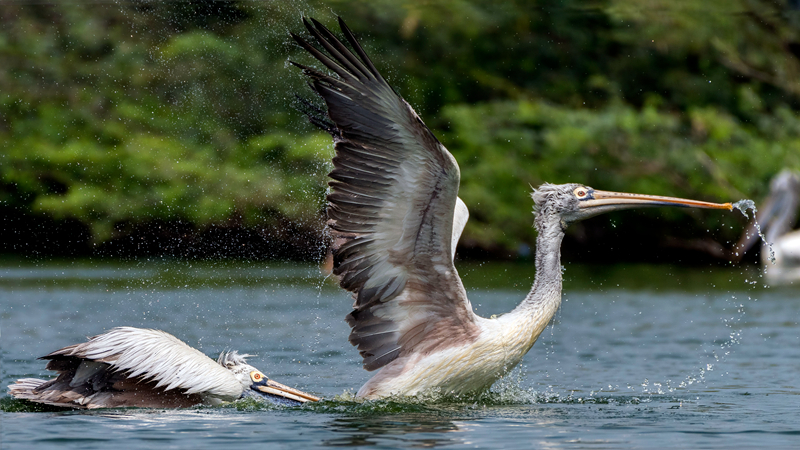
“Why is it that the birds seem to be all moving at once?” I asked of William during the first moment of partial leisure that we had, “and why are they all going in the same direction?”
“It is a question of food with them,” he replied, “as is the case with most other animals. Widgeon can only get their food by reaching down for it, so they must keep where the water is not over their heads; that is so that they can touch bottom with their bills by tipping up, as you have often seen tame ducks do. Now in these shallow marshes a change of wind means a change of depth of water, it is shallower to windward, the water being piled up to lee-ward and the ducks, knowing this, fly against the wind, all the shoal feeding birds do so. The canvas-backs, red-heads, and broad-bills make little account of the wind.”

“But,” I answered, “this wind cannot as yet have affected the depth of water.”
“No, but the birds know that it soon will, and they are getting ready for to-morrow. There will probably be a greater change than we expect, wild animals know much more about the weather than man can ever learn, they have a sort of instinct that is given to them for their protection. I have always observed that the ducks sought the windward side of the marshes. If the wind is blowing from the south, I make it a rule to go to the southward to choose a stand, if from the west I look through the western marshes and so on. Of course I am not always right.”
“No,” I interrupted him to remark, “but we have observed that the member who goes out with you generally brings in the most birds, so the results tend to demonstrate the theory.”
“Well, I have studied these marshes as thoroughly as I could; there is not a tree that I have not climbed, nor an island that I have not explored.”
“Can you see much from the trees when you do climb them?” I asked.
“Yes. A little elevation will enable you to see over the entire marsh, and many a pond hole have I found in that way that is not known to most of the gunners, and not always to the natives.”
“Keep still,” I remarked at this point of our conversation, “there comes a magnificent flock of ducks, if they would only turn this way what a shot they would give us.”
We were silent except for whistling, which we did with the finest touches and the utmost skill. The flock, spread out against the distant sky in an angle-pointed line, was headed directly for our hiding place. We had crouched down on their first appearance, and grasping our guns and watched them, waiting with increasing impatience and anxiety. Nearer and nearer they came, over the distant marsh undisturbed by any other gunner, and unattracted by other decoys until they were directly in front of us and not more than three hundred yards distant. It was a moment of intense excitement, for if we could once get our four barrels into those serried ranks, there was no telling how many we might not kill.