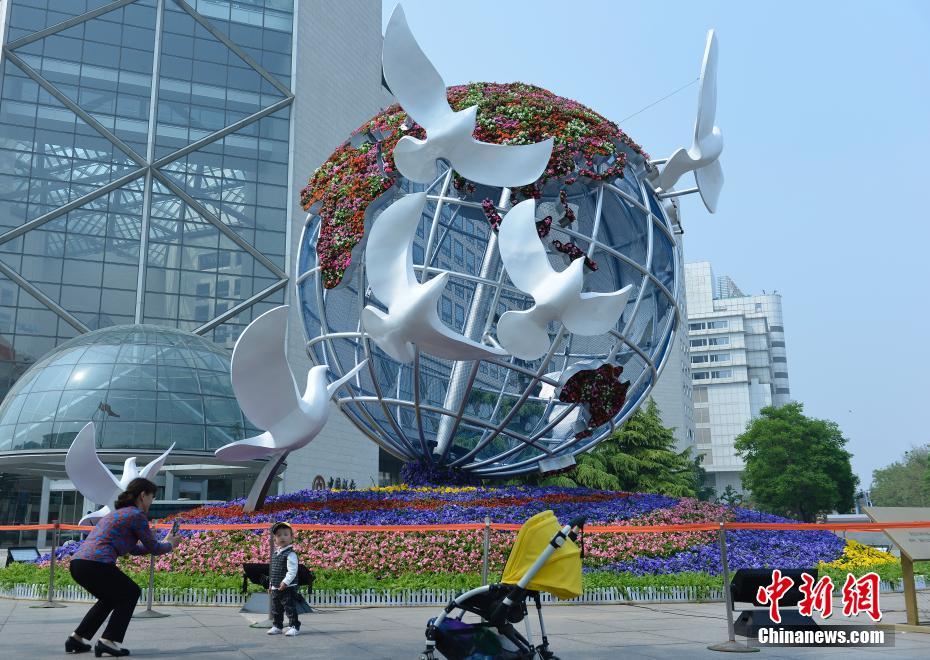
Reunification monument in Yaoundé, Cameroon. Photo released under Creative Commons by Steve Mvondo. Last month, President Paul Biya announced that the long delayed celebrations marking the 50th anniversary of reunification of the British Southern Cameroons and the Republic of Cameroun (ex-French Cameroons) would take place in Buea, the former capital of Southern Cameroons, on February 20, 2014. This was three years late and on a date that had no historical significance or link to either the independence of the French Cameroons (January 1, 1960) or the reunification of the British and French Cameroons (October 1, 1961). Writer George Ngwane, like many Cameroonians, questioned the choice of the date: Did the state leadership not know that 1st October 2011 was the real date of the 50th anniversary of Reunification? Shall we remember 20th February 2014 more as the day President Biya visited Buea or the day the Golden Jubilee Reunification event took place? As expected, the celebrations revived the never-ending questions about the state of the union between Anglophone and Francophone Cameroon. For example, user @mapetiteniche tweeted a question that was on the minds of many: Today we celebrate the 50th reunification of cameroon.I wonder if more or less progress will have been done had we been 2 separate countries — Lo (@mapetiteniche) February 20, 2014 An article on Matango blog on the marginalization of the Anglophone Cameroonians provided an unequivocal answer [fre] – the British Southern Cameroons got a raw deal in its “marriage” to the French-speaking La Republique du Cameroun: La marginalisation du Cameroun anglophone est une habitude, voire un système bien pensé qui est mis en place depuis fort longtemps et qui structure la gouvernance… Cette marginalisation continue et se manifeste dans les faits par une attention de moins en moins soucieuse du développement de cette région riche en ressources. Des richesses accaparées par la partie francophone. Dans les actes de nomination et de dotation en infrastructures, cette partie a toujours été reléguée en second plan dans les priorités de l’Etat « unitaire », estiment ces leaders. Que célébrons-nous donc ce 20 février 2014, si ce n’est pas une marginalisation de plus ? The marginalization of Anglophone Cameroon is a habit, indeed a well-thought-out system put in place long ago which shapes governance [in Cameroon]… This marginalization continues to this day and is manifested in practice by less attention being paid to the development of this region rich in resources. Riches monopolized by the Francophone section. Anglophone leaders feel that in appointments and the allocation of infrastructure, the English section is always relegated to a position of secondary importance in the priorities of the “unitary” state. What therefore are we celebrating on February 20, 2014, if not another act of marginalization? The status of Anglophone Cameroon within the union was very present throughout the celebrations. One such occasion was a nationally televised round table on reunification at the University of Buea chaired by Prime Minister Philemon Yang. During the discussion, a leading Southern Cameroons nationalist, Mola Njoh Litumbe, questioned the legality of the union between Southern Cameroons and La Republique du Cameroun and insisted that “”Reunification was like illegal courtship – a concubine relationship.” While some found his views extreme, there was emerging consensus, particularly among Anglophones, that the time was ripe for a reappraisal of the union between the two Cameroons. This view was echoed by writer George Ngwane, who argued that: As long as human beings resolve to push the boundaries of injustice to the frontiers of freedom, there shall be internal agitations within and between nations to the point of new constitutional engineering and the birth of new nation-states. To this end, he posited that the time was ripe for another referendum to determine the future of the former British Southern Cameroons: So if the future of Southern Cameroons was decided through a Referendum (Plebiscite) on 11th February 1961, and the future of West Cameroon was determined through a Referendum on 20th May 1972, is it not logical that the future of the British Southern Cameroon, Southern Cameroons, West Cameroon or Anglophone Cameroonians, and they only, should be consulted, through another Referendum? Forgotten heroes and personality cult To many Cameroonians, the 50th anniversary celebration was an opportunity for the country to finally reconcile with its violent decolonization history and celebrate its nationalist heroes, many of whom were exiled and assassinated for challenging the colonialists.
Fashion
Divisions Persist in Cameroon Despite Reunification’s Grandiose Golden Jubilee
Tags
Related reading