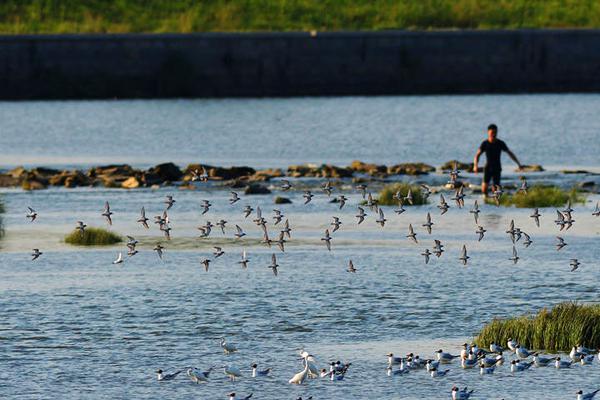
“Still another plane is to be found in the Red-wing’s dismal cousins, the Grackles,—Purple, Rusty, Bronzed, and Boat-tailed,—all harsh of voice and furtive in action, as if a Crow fairy had been present at their creating and, endowing them with ready wits, had, at the same time, deprived them of all sense of humour and cast a shadow upon their happiness. For a Grackle is gloomy even during the absurd gyrations of his courtship, and when, in autumn, the great flocks settle on lawns and fields, and solemnly walk about, as they forage they seem like a party of feathered mutes waiting to attend the funeral of the year; and this trait somewhat tinctures the disposition of the Red-wing before and after the breeding season.
“The Red-wing in one of his many subspecific forms, and masquerading under many names,—Red-shouldered Blackbird, American Starling, and Swamp Blackbird,—lives in North America from Nova Scotia and the Great Slave Lake southward to Costa Rica. The Red-wing, as known to us of middle and eastern North America, breeds in all parts of its United States and Canadian range, though it is more numerous by far in the great prairies of the upper Mississippi Valley, with their countless back-water sloughs, than anywhere else. It is in regions of this sort that the great flocks turn both to the fall-sown grain, as well as that of the crop in the ear, causing the farmers the loss that puts a black mark against the Red-wings. Yet those that dwell east of this area, owing to the draining and ditching of their swampy haunts being in much reduced numbers, are comparatively harmless.

“During the winter months the Red-wings are distributed throughout the South, though stragglers may be occasionally seen in many parts of their summer range. Exactly why they begin the southward migration in September and end it with the falling of the leaves in late October, it is not easy to guess; for the food supply is not at an end, and they do not dread moderate cold, else why should they be in the front rank of spring migrants?

“The last of February will bring a few individuals of the advance-guard of males. In early March their calls are heard often before the ice has melted and the hylas found voice; yet in spite of this hurried return, the nesting season does not begin until the middle of May; and so for two months and more the flock life continues, and foraging, fighting, and general courting serve to kill time until the remote marshes show enough green drapery to hide the nests.